We love it when
a plan comes together.

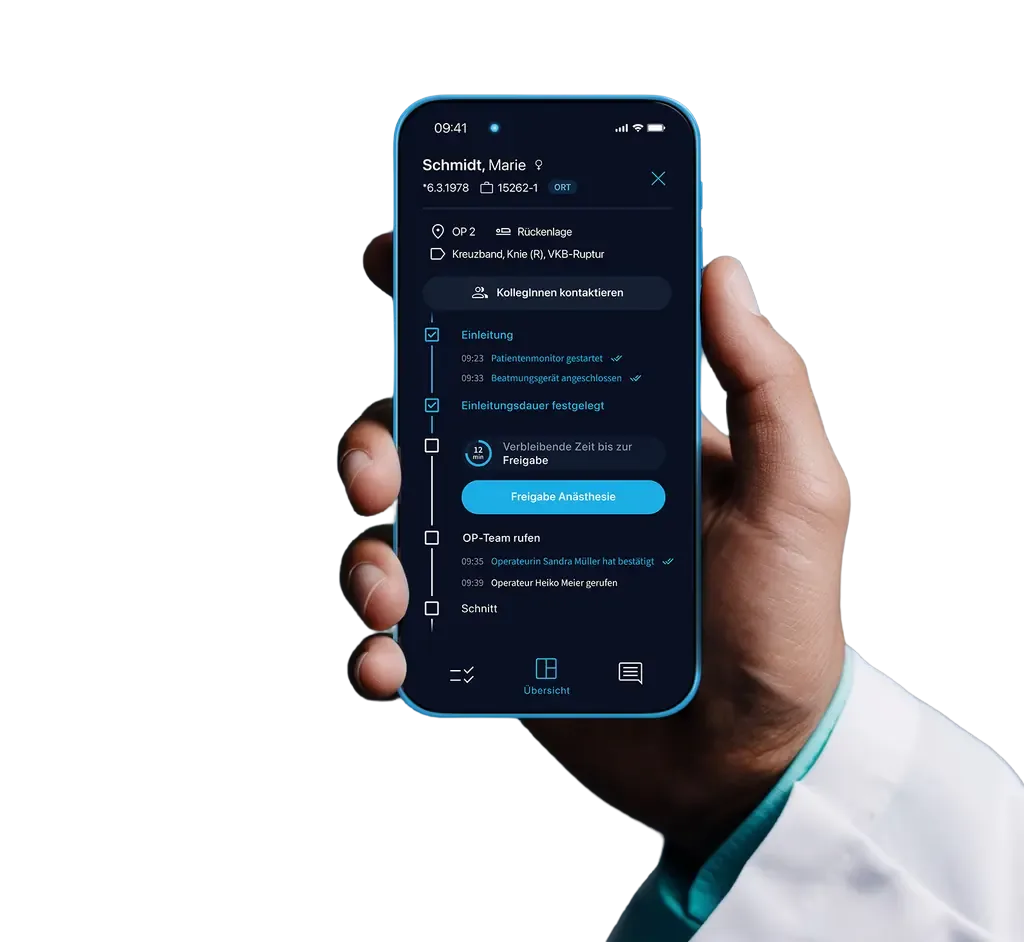
The ideal OR schedule is set – and then reality hits. The digital OR coordination assistant helps achieve the best outcome: fewer cancellations, shorter turnover times, better collaboration.

OR management,
light-years ahead.

Fully automated. Higher utilisation, fewer phone calls. Reach your OR management goals through better collaboration across all professional groups – from admission to recovery.

Distant goals, suddenly within reach.

Optimised OR utilisation

More cut-to-suture minutes, shorter turnover times, less idle time – measurable and lasting.

Automated OR coordination

Intelligent planning and control of all OR processes – automatic, in real time, without manual intervention.

74% fewer phone calls

Less coordination effort, fewer unnecessary calls. And more time for the conversations with colleagues that matter.

Find the black holes
in your OR schedule.

Donnerstag, 7. März
14:32
sqior now

Your N4 add-on case from 12:32 can already be operated today at 16:32 in OR 2.

Appointment accepted

Jane Doe

Femoral neck fracture

The following steps are carried out automatically:

  1. CSSD: instrument tray availability checked

  2. OR schedule updated

  3. OR team notified

    • · Surgical team scheduled
    • · Anaesthetist confirmed
  4. Induction 3 notified

    Overlapping induction with the preceding procedure likely possible

  5. Transport order created

    LOGBUCH transport requested, porter being assigned. Expected transport time to holding area: 24 minutes.

  6. Post-op ward notified

    Bed 8B reserved · handover announced

  7. Recovery room being notified

  8. Post-operative sign-out

sqior OR Assistant

Online

How are we doing with the checklists?
how could we improve even further?
|

Room

Connects what belongs together.

One platform. All systems: when something important happens, we send you a message. That's how seamless, intuitive workflows come about.

  • HIS integration
  • Logistics integration
  • Monitoring & anaesthesia devices
  • PDMS systems
  • Wards & day clinics
  • CSSD/sterilisation
  • Intra-op medical technology
  • Intensive care units

OR management in action.

What our users say:

I can make much better use of the time until the next surgery.
Dr. Göntje Peters Deputy Clinic Director, Gynecology and Obstetrics, University Hospital Schleswig-Holstein
No waiting times and better processes.
Helge Semrau-Meierewert OR Coordinator, University Hospital Schleswig-Holstein
Faster handover times and better communication.
Jann Niklas Ufen Anesthesia Technician (ATA) in training, University Hospital Schleswig-Holstein
My everyday work has become easier thanks to the app – I save myself countless phone calls.
Bastian Schmidt Deputy Team Lead Trauma Surgery, OR Service Center, University Hospital Schleswig-Holstein

Is time in your OR still relative?

Together with you, we build elegant, digital OR workflows – just as they should be. Powered by the most advanced AI models, built for everyday life in the OR.

Our OR assistant is the most widely used AI-based OR assistance system and supports thousands of surgeries every day. We'd be glad to show you the system in action or put you directly in touch with one of our customers.

Frequently asked questions

Can sqior also show when our instrument trays are available?
Yes. We integrate with the existing sterile-supply/CSSD software and make sure it is seamlessly embedded in the OR process and that, in case of possible problems with tray provision, measures are taken early.
Which areas and professional groups can be involved, e.g. ward, transport, cleaning, CSSD, etc.?
All areas involved in the process: ward, nursing, medical staff, transport, cleaning, CSSD/sterile supply, emergency department, intensive care, among others. Each professional group gets its own role-appropriate view and only the notifications relevant to them.
Can the assistants be adapted to our workflows – even if they are quite different from those shown on the website?
Yes. Our assistants don’t come with standard workflows or technical templates the way classic legacy software did. They are trained on your hospital’s workflows, roles and notification rules; proven templates are only a starting point. And rather than just engraving your processes 1:1 into the assistant, we continuously provide improvement suggestions – otherwise we’d be doing something wrong :-)
Do the digital assistants create double documentation?
No: our digital assistants are meant to take work off your hands – not create extra. Data is taken from the existing systems (HIS/PDMS) and – where it makes sense – written back. Nursing keeps documenting in its familiar environment. Our assistants, however, steer the workflow and measurably reduce the number of necessary phone calls.
Does every hospital employee need a smartphone for sqior, or can we use our DECT phones too?
A smartphone is ideal, but not a requirement. Our assistants can use all the devices you already have: alongside the iOS, Android and web client there are embedded clients in medical technology and a DECT integration. Notifications are then delivered to your existing DECT phones and can be answered directly with a quick reply. What matters is that every professional group gets the best possible access with as few technical hurdles as possible.
Can private smartphones be used for sqior too?
Yes. sqior supports both hospital-owned devices and BYOD. On private devices the data runs sandboxed in the app or via the hospital’s MDM; no patient data is stored locally. We follow your device policy.
How is sqior connected to the HIS, PDMS and other systems, how much effort is it for our IT – and can data be written back too?
Interfaces in hospital IT used to be a frequent problem with legacy software. For our AI assistants that is no longer the case. They simply fetch the data you release. We have bidirectional interfaces to more than 70 vendors and use all the established interface technologies (such as HL7, FHIR, REST). Our assistants can also access other systems directly to acquire the required data manually. You can picture it as a colleague logging into the respective hospital software, reading out/entering the data – except that our AI assistants do this automatically (via RPA in the UI or on deeper IT layers). The way back works too: via HL7/FHIR sqior writes relevant events back into the HIS.
Does sqior work across multiple sites and different HIS?
Sure – our assistants are used by many networks or hospitals with multiple sites and sometimes different HIS systems. For users this creates a consistent experience despite very different (sub-)systems.
What is the data protection concept?
Professional data protection is not an option for our digital assistants but a basic requirement. We process your personal data not in a cloud but locally, on site in your hospital, GDPR-compliant and in line with ISO 27001. On this basis, we sign an individual data processing agreement (DPA) with you, setting out general and individual technical and organisational measures to protect the data of your patients and staff.
Is there a way to test the digital assistant?
Sure. Working with digital assistants changes collaboration in the hospital a great deal (positively :-)). We want you to have this experience as early as possible. Ideally, talk directly to our users as well – about possible concerns, the expected benefits and the possible challenges of implementation. We have nothing to hide and are proud of every single installation.
How long does it take to introduce a sqior digital assistant in the hospital?
In most cases the assistants start working within a few days and are then trained over a period of a few weeks so that they can actively support. The time for a full integration varies among our customers between 3 weeks and 3 months.
How much effort is the training?
Little. sqior is designed to be self-explanatory (an assistant principle instead of menu trees). For most users a short briefing is enough; key users are trained a bit more thoroughly. Training material and support during the rollout are part of the introduction.