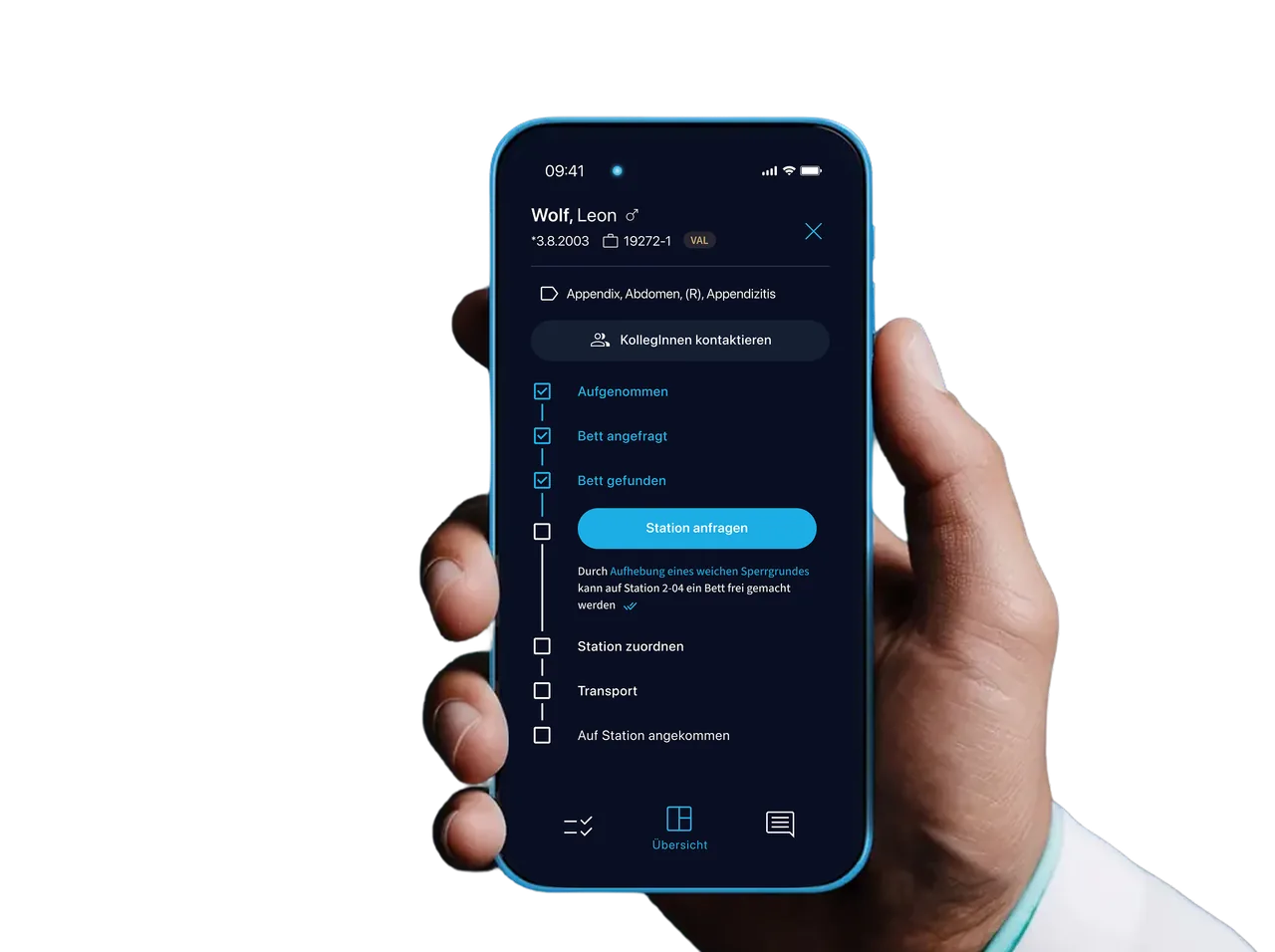
Bed management
that truly delivers.

Bed allocation often resembles a bazaar. Emergencies, elective planning, and ICU collide. Our assistant automates allocation and enables effective capacity management. No phone calls. No negotiations.

The true revolution in bed allocation.

Bed request with one click

Instead of coordinating by phone, a single click is all it takes to request a bed. The assistant handles the coordination.

Automatic allocation suggestions

Intelligent suggestions for the optimal target ward based on availability and patient needs.

Real-time occupancy information

Up-to-the-second occupancy data for the entire hospital – from outpatient to intensive care.

Automated discharge notifications

Discharges are automatically reported and freed beds instantly made available in the system.

Automated follow-up queries

In case of uncertainties like bed blocks, follow-up queries are automatically sent to responsible parties.

Digital allocation status

Your individual allocation process is digitally mapped and consistently enforced.

A direct path to optimal bed allocation.

End-to-end capacity management:

Emergency Department

Bed requests directly from the ED software

LDAP

Single sign-on through central user management

HIS / EMR

EPIC, Orbis, CGM, Avelios, SAP ish.med, KISIM

Outpatient Portal

Admission requests from outpatient clinics integrated

OR

Bed demand for surgical patients in real time

Intensive Care

Admissions and transfers fully coordinated

Bed Logistics

Bed status and transports in real time

Cleaning

Cleaning services automatically dispatched

Patient Transport

Patient transports automatically coordinated

Discharge Management

Discharges and bed release automated

The digital bed-management assistant in action.

What our users say:

The app saves us a lot of time, improves communication, and ensures fair bed allocation.
Aline Munko Bed Manager, LMU Hospital
Outflow from the emergency department is significantly improved.
Benjamin Petz Bed Manager, InnKlinikum Altötting
Digitizing bed allocation enabled a real leap in quality across our hospitals.
Thomas Ewald CEO, InnKlinikum

Less bed Tetris. More structure in everyday hospital life.

Our bed management makes better use of your capacity – fairly, transparently and visible to everyone. Write to us and we will get back to you within one business day.

Frequently asked questions

Is it possible to carry out in-house transfers with sqior too, or only new admissions?
Of course – this is usually where the music plays! Besides new admissions, our assistants also optimise internal transfers, for example to reduce boarding patients, to steer the recovery room and the ICU as well as possible, or to distribute the load between departments as fairly as possible by nursing effort in case of illness.
Discharges aren’t always recorded precisely with us. Can sqior help?
In legacy hospital software you always had to enter everything precisely for processes to work. Our assistants turn this around: when in doubt they simply ask, instead of expecting perfect input. This leads to a markedly improved process quality.
Can the assistants be adapted to our workflows – even if they are quite different from those shown on the website?
Yes. Our assistants don’t come with standard workflows or technical templates the way classic legacy software did. They are trained on your hospital’s workflows, roles and notification rules; proven templates are only a starting point. And rather than just engraving your processes 1:1 into the assistant, we continuously provide improvement suggestions – otherwise we’d be doing something wrong :-)
Do the digital assistants create double documentation?
No: our digital assistants are meant to take work off your hands – not create extra. Data is taken from the existing systems (HIS/PDMS) and – where it makes sense – written back. Nursing keeps documenting in its familiar environment. Our assistants, however, steer the workflow and measurably reduce the number of necessary phone calls.
Does every hospital employee need a smartphone for sqior, or can we use our DECT phones too?
A smartphone is ideal, but not a requirement. Our assistants can use all the devices you already have: alongside the iOS, Android and web client there are embedded clients in medical technology and a DECT integration. Notifications are then delivered to your existing DECT phones and can be answered directly with a quick reply. What matters is that every professional group gets the best possible access with as few technical hurdles as possible.
Can private smartphones be used for sqior too?
Yes. sqior supports both hospital-owned devices and BYOD. On private devices the data runs sandboxed in the app or via the hospital’s MDM; no patient data is stored locally. We follow your device policy.
Does sqior work across multiple sites and different HIS?
Sure – our assistants are used by many networks or hospitals with multiple sites and sometimes different HIS systems. For users this creates a consistent experience despite very different (sub-)systems.
What is the data protection concept?
Professional data protection is not an option for our digital assistants but a basic requirement. We process your personal data not in a cloud but locally, on site in your hospital, GDPR-compliant and in line with ISO 27001. On this basis, we sign an individual data processing agreement (DPA) with you, setting out general and individual technical and organisational measures to protect the data of your patients and staff.
Is there a way to test the digital assistant?
Sure. Working with digital assistants changes collaboration in the hospital a great deal (positively :-)). We want you to have this experience as early as possible. Ideally, talk directly to our users as well – about possible concerns, the expected benefits and the possible challenges of implementation. We have nothing to hide and are proud of every single installation.
How long does it take to introduce a sqior digital assistant in the hospital?
In most cases the assistants start working within a few days and are then trained over a period of a few weeks so that they can actively support. The time for a full integration varies among our customers between 3 weeks and 3 months.
How much effort is the training?
Little. sqior is designed to be self-explanatory (an assistant principle instead of menu trees). For most users a short briefing is enough; key users are trained a bit more thoroughly. Training material and support during the rollout are part of the introduction.